LiftMaster gate operators are motorized systems that control gate operation and respond to commands from keypads, sensors, and smart devices. Every component inside the operator has a specific job, and each one works together to move the gate accurately, consistently, and on command.
Getting familiar with what each part does is exactly what every property owner needs before moving forward with a gate operator installation. This guide covers every major component of a LiftMaster gate operator, from the motor and drive system to the smart technology that connects it to your phone.
What Makes a Gate Operator Different From a Regular Gate?
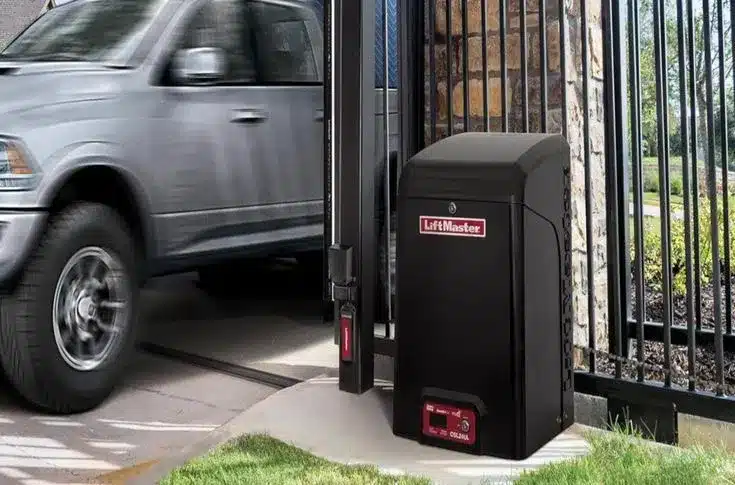
A gate operator is a motorized system that automates the opening and closing of a gate, giving property owners full control over who enters and exits through any access point on their property.
Here is what separates a gate operator from a standard manual gate:
- A motor unit drives the gate open and closed through a mechanical drive system
- A control board processes every command from keypads, remote controls, and access devices
- Safety sensors detect obstructions in the gate’s path and trigger an immediate stop to protect people and vehicles
- A power source with battery backup keeps the system running even during an outage
- Programmed timers and smart connectivity allow the gate to operate automatically without manual input
To understand how each of these components comes together in one complete system, read our guide on LiftMaster Gate Operators: Features & Benefits, which breaks down every feature and function that powers your gate from signal to stop.
How LiftMaster Gate Operators Work
Motor and Drive System
High-torque motors power every LiftMaster gate operator, converting electrical energy into the mechanical force needed to move gates of different sizes and weights.
How the motor and drive system control gate movement:
- Slide operators use a chain or gear mechanism along a fixed track
- Swing operators use linear actuator arms that extend and retract through a full arc
- Motors are rated by maximum gate weight measured in lbs
- Smooth start technology gradually accelerates the gate at the beginning of each cycle
- High-cycle motors are available for commercial properties with heavy daily use
Each motor unit maintains consistent torque output across varying environmental conditions to ensure accurate, controlled operation of the automatic gate system.
Control Board and Intelligence
Every command the gate receives passes through the control board first, making it the decision-making center of the entire operator system.
What the control board manages during every gate cycle:
- Stores programmed settings for gate speed, direction, and travel distance
- Triggers automatic gate closure after a set time through timer-to-close settings
- Routes all signals from keypads, remote controls, and safety sensors before any movement occurs
- LiftMaster access control technology is embedded for precise entry and exit management
- Accepts programming adjustments directly on the board or through the myQ app
The control board monitors system performance in real time and flags irregular behavior before gate operation is affected.
Safety Entrapment Protection
Meeting UL 325 standards is mandatory for all gate operators sold in the United States, and LiftMaster builds multiple layers of entrapment protection into every unit.
Gate safety features built into every LiftMaster operator:
- Inherent reversal sensors automatically reverse the gate when resistance is detected
- Photo eyes stop operation the moment the beam across the opening is broken
- Edge sensors reverse the gate immediately upon physical contact
- Sensors are classified as B1 or B2 under UL 325 based on the detection method
- Multiple gate safety sensors run simultaneously for layered active protection
Every entrapment protection layer works independently, so gate safety is maintained even if one sensor type is temporarily affected.
Power Management and Battery Backup
Operating on 24V DC gives LiftMaster gate operators a strong energy efficiency advantage while keeping the gate fully operational during power interruptions.
How power management works across a full LiftMaster system:
- Draws from the main supply while keeping the battery charged during normal operation
- Battery backup activates instantly when power is interrupted, with no delay
- The gate can be programmed to open, close, or hold position during an outage
- 24V DC draws less power overall than traditional AC-powered systems
- Multiple backup cycles are available on a single charge during extended outages
Power configuration options vary by model and depend on the gate’s daily cycle count and property requirements.
Connectivity via myQ Technology
myQ transforms a standard LiftMaster gate opener into a fully connected access point that property owners can monitor and control from anywhere.
What myQ technology delivers to every connected gate system:
- Sends real-time alerts every time the gate opens or closes
- Remote commands go directly through the myQ app without a physical remote
- Access schedules limit gate operation to programmed hours only
- myQ Community extends centralized control to multi-unit and commercial properties
- HomeLink lets drivers operate the gate from compatible vehicle controls
Smart access through myQ gives property owners a level of visibility and control that no traditional gate opener system can match.
Key Operational Features That Control How Your Gate Behaves
LiftMaster gate operators come equipped with built-in features that give property owners precise control over how their gate responds to every situation.
What these operational features control on every LiftMaster system:
- Auto-close timer shuts the gate after a programmed period
- The quick close feature returns the gate to the closed position after a vehicle clears
- Anti-tailgate settings block a second vehicle from entering before the gate resets
- Loop detectors confirm the opening is clear before triggering a closed cycle
- Keypads, card readers, and intercoms connect directly for expanded access control
- myQ scheduling limits gate operation to specific programmed hours
Every feature works together to keep gate operation consistent and controlled across any Sacramento residential or commercial property.
The Different Types of LiftMaster Gate Operators
LiftMaster offers multiple gate operator types, each engineered to match a specific gate design and the access demands of the property it serves.
What each operator type is built for:
- Industrial operators rated for extreme daily use in high-demand facilities
- Heavy-duty operators are built for larger and heavier gates on commercial properties
- Barrier operators control vehicle entry and exit at parking lots and gated communities
- Swing operators use linear actuator arms to move single or dual panels in an arc
- LiftMaster slide gate operator runs horizontally for limited-clearance properties
- Specialty operators handle unique configurations that standard setups cannot accommodate
To find the operator type that fits your specific property setup, read our guide on Which LiftMaster Gate Operator Is Right for Your Property?, which breaks down every option based on gate design, property type, and access needs.

Benefits of LiftMaster Gate Operators for Every Type of Property
LiftMaster gate operators deliver measurable advantages through smart technology, strong construction, and consistent gate performance.
What LiftMaster gate operators bring to every property:
- Built to withstand years of reliable use across demanding environmental conditions
- Automated access control reduces unauthorized access at every entry point
- myQ smart connectivity gives property owners real-time visibility and remote control
- Battery backup keeps the gate fully operational through any power interruption
- Compatible with keypads, intercoms, card readers, and other access control accessories
- Low-maintenance design means less need for LiftMaster gate operator repair over the life of the system
To explore whether these advantages match what your property needs, read our full breakdown on Are LiftMaster Gate Operators Worth It?, which covers performance, value, and long-term results in detail.
LiftMaster Gate Operators Are Engineered to Work Smarter for Every Property
LiftMaster gate operators are built with precision motor systems, intelligent control boards, and multi-layer safety features to deliver consistent, automated gate operation for any property type. Every part of a LiftMaster unit, from the drive system to the myQ technology, is engineered with a specific purpose in mind.
Whether you live in Auburn, Elk Grove, Folsom, Rancho Cordova, Citrus Heights, Galt, West Sacramento, East Sacramento, Land Park, Natomas, Oak Park, Davis, Roseville, or Rocklin, Central Valley Gates & Access Controls can secure your property and make your home into your castle!
Contact us or give us a call today, and we will help you find the LiftMaster gate operator that fits your property and access needs perfectly.